UP ISSI Participates in the 6th SEASIA Biennial Conference
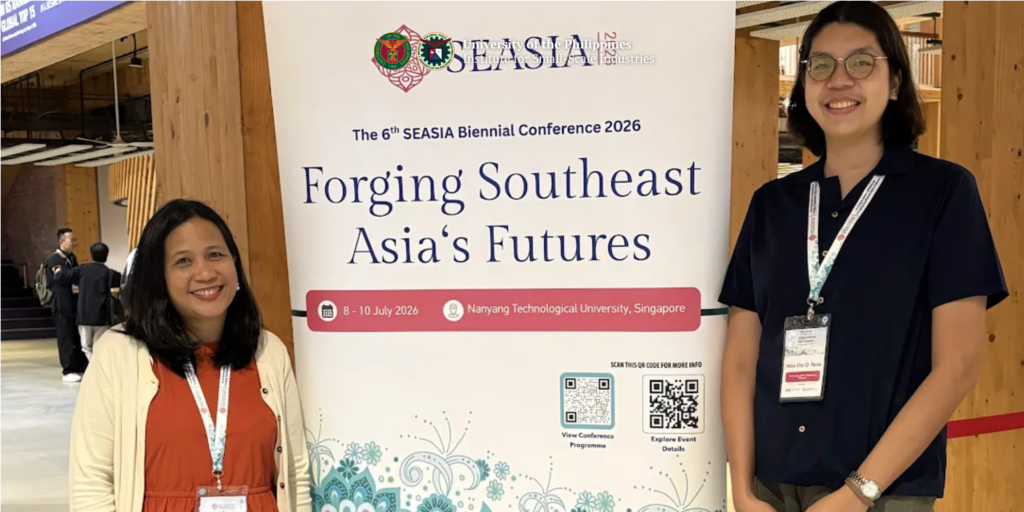
The University of the Philippines Institute for Small-Scale Industries (UP ISSI) participated in the 6th SEASIA Biennial Conference, held from July 8 to 10, 2026, at the School of Social Sciences of Nanyang Technological University in Singapore.
Ms. Mika Ella O. Perez and Ms. Melanie V. Cabotaje, both University Extension Specialists in UP ISSI’s Research Division, presented their respective papers during the conference’s breakout sessions.
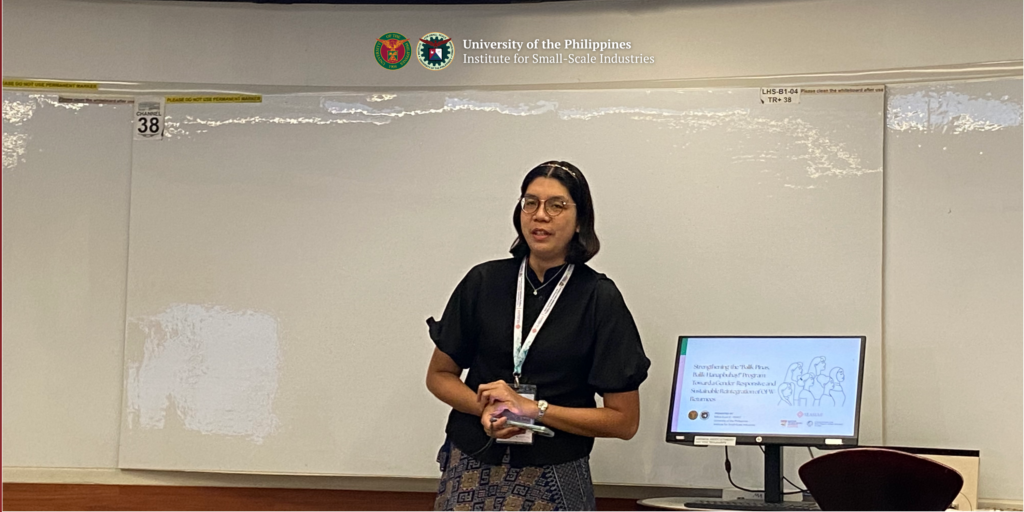
Ms. Perez’s presentation, “Strengthening the Balik-Pinas! Balik-Hanapbuhay! (BPBH) Program Toward a Gender-Responsive and Sustainable Reintegration of OFW Returnees,” reported the findings of a study assessing the BPBH Program, one of the Philippines’ reintegration initiatives for returning overseas Filipino workers (OFWs). The study found that the program plays an essential but limited role in the reintegration of OFW returnees. Its principal strength is the timely provision of direct, tangible financial assistance during periods of distress and vulnerability. Beneficiaries regarded the program as helpful not only because of the one-time grant but also because it offered hope and direction following their sudden and difficult return. The findings, however, identified several limitations: the absence of a gender-responsive approach despite the predominance of women beneficiaries; inadequate financial assistance and capacity building; institutional and structural constraints; and weak interagency coordination. The study recommended clarifying the program’s goals and aligning its interventions accordingly. More broadly, it called for a shift in program philosophy and implementation – from relief to transformation, from isolated action to coordinated support, and from generic assistance to differentiated interventions.
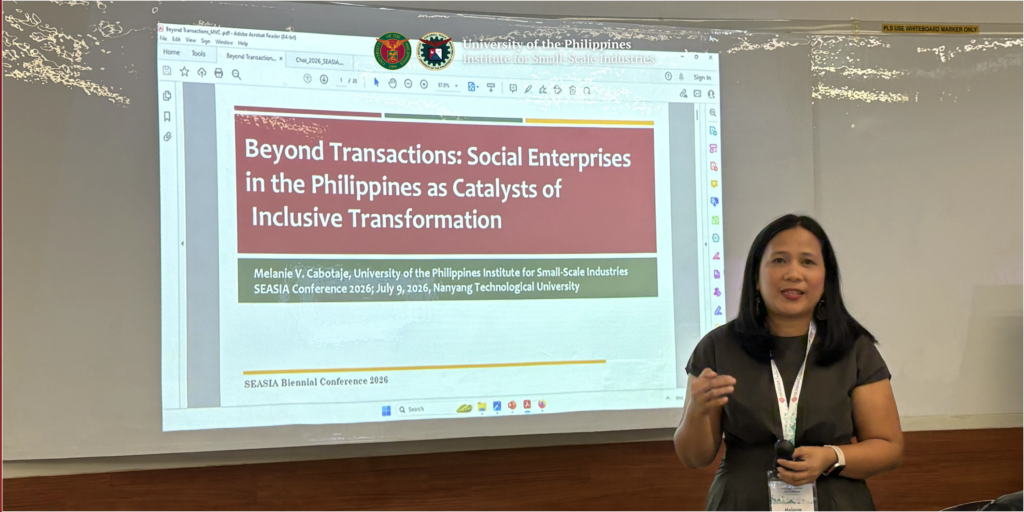
Ms. Cabotaje’s presentation, “Beyond Transactions: Social Enterprises in the Philippines as Catalysts of Inclusive Transformation,” examined how Philippine social enterprises translate their social missions into concrete organizational and business practices. Drawing on a national survey of 204 social enterprises and case studies of Human Nature, CAMP International, and IGTING, the study identified three dimensions of inclusive transformation: meaningful stakeholder engagement, equitable redistribution of economic value, and the development of long-term agency. The cases illustrated distinct pathways to transformation, including fair sourcing, living wages, community organizing, enterprise incubation, cooperative ownership, and shared governance. The presentation showed how social enterprises move beyond charitable transactions by enabling marginalized groups to become workers, suppliers, partners, leaders, and decision-makers. It concluded that sustained transformation through social entrepreneurship requires a supportive ecosystem comprising an enabling legal framework, hybrid financing, preferential public procurement, and capacity-building assistance.
The 6th SEASIA Biennial Conference: Forging Southeast Asia’s Futures
The theme, “Forging Southeast Asia’s Futures,” framed the conference as an active inquiry into how diverse actors – states, communities, institutions, artists, educators, and technologists – shape the region’s trajectories amid shifting geopolitical, economic, environmental, and digital forces.
The conference was organized by the Nanyang Technological University School of Social Sciences and the Consortium for Southeast Asian Studies in Asia (SEASIA). SEASIA is a network of 16 research institutions across Asia, with members from Japan, Korea, Taiwan, China, Hong Kong, the Philippines, Malaysia, Indonesia, Singapore, Brunei, Thailand, and Cambodia. The consortium was established in Kyoto, Japan, in 2015.
Across its opening and keynote addresses and breakout sessions, the conference centered on agency: the everyday and strategic capacity of people and organizations to navigate, contest, and reshape structures of power and create multiple, competing pathways to the future.
In his welcome remarks, SEASIA Chair Professor Hsin-Huang Michael Hsiao emphasized the consortium’s mission to facilitate academic exchange and nurture scholars in Southeast Asian studies. He described the conference as a venue for dialogue and collective reflection on building a secure, peaceful, resilient, and prosperous region.
Professor Yohanes Eko Riyanto, Chair of the School of Social Sciences under Nanyang Technological University’s College of Humanities, Arts, and Social Sciences, described Singapore as a fitting crossroads for the conference and called on participants to forge new partnerships in light of the region’s centrality to global conversations on geopolitics, climate change, digital transformation, and demographic shifts. He urged participants “not only to examine, but to recognize the many ways we actively negotiate that future.”
Associate Professor Kei Koga, a SEASIA Committee member and Head of Public Policy and Global Affairs in Nanyang Technological University’s School of Social Sciences, noted that Southeast Asia is undergoing major political, economic, and technological transformations to which the region is responding in diverse and creative ways. He encouraged participants to use informal settings, including coffee breaks and dinners, for meaningful exchange.
Dr. Chan Heng Chee, Ambassador-at-Large at the Ministry of Foreign Affairs, delivered an opening address covering three broad areas: the history of Southeast Asian studies, the contemporary relevance of ASEAN and Southeast Asian studies, and the need for academic relevance. She traced the evolution of Southeast Asian studies from colonial-era scholarship and post-World War II American area-studies programs to the emergence in the 1970s of a self-conscious community of Asian scholars who began producing ASEAN-centric knowledge and “talking back” to Western frameworks. She credited funding from Japanese and U.S. foundations, along with the Fukuda Doctrine, with catalyzing regional academic solidarity.
The Ambassador then explained how geopolitical and geoeconomic shifts – including the China+1 strategy, the Regional Comprehensive Economic Partnership (RCEP), the Comprehensive and Progressive Agreement for Trans-Pacific Partnership (CPTPP), and the weakening of the rules-based order – have made ASEAN more strategically relevant than ever. Citing funding allocations of S$450 million for 2021-2025 and S$556 million for 2026-2030 to Singapore’s Social Science Research Council, she argued that institutional support for social science and humanities research remains strong in Asia.
The Ambassador concluded with a call for relevance, urging Southeast Asian scholars to pursue policy-relevant, multidisciplinary research; write op-eds that reach policymakers; and remain grounded in disciplinary rigor even when working across fields. Warning against academics becoming “society’s expensive pets,” she argued that Southeast Asian studies will thrive when scholarship moves beyond publication to address urgent real-world concerns and serve society.
The first keynote address was delivered by Sri Mulyani Indrawati, former Minister of Finance of the Republic of Indonesia. She examined how ASEAN could sustain prosperity and avoid the middle-income trap amid slowing and increasingly fragmented global trade, population aging, geopolitical tensions, technological disruption, climate change, and rising public expectations. She argued that the development model anchored in abundant labor, export expansion, and participation in global value chains was reaching its limits. She identified productivity, human capital, and technological capability as the principal drivers of ASEAN’s future competitiveness.
She stressed that governments must narrow the substantial productivity gap between advanced firms and the many small, informal, and low-productivity enterprises. Proposed measures included investing in research and development, accelerating technology diffusion, encouraging innovation, strengthening competition policy, and improving access to finance, infrastructure, logistics, and markets. She added that productivity initiatives should extend to agriculture and rural communities through better irrigation, reduced post-harvest losses, digital financial inclusion, stronger agricultural value chains, and climate-resilient production.
Although artificial intelligence could improve manufacturing, logistics, healthcare, agriculture, public administration, and financial inclusion, she cautioned that it could also displace labor-intensive work. ASEAN should therefore use technology to enhance human capabilities by improving the quality of education, strengthening technical and vocational training, and promoting collaboration among governments, universities, and industries. She further argued that education systems must cultivate digital and technical competencies alongside problem-solving, adaptability, communication, teamwork, leadership, and lifelong learning.
The keynote address also underscored the need for capable, accountable, and resilient states. Governments must provide foundational infrastructure, correct market and environmental failures, promote fair competition, coordinate policies, and strengthen food and energy security while maintaining fiscal discipline and macroeconomic stability. Fulfilling these responsibilities requires professional public institutions, sound governance, transparency, and safeguards against corruption and elite capture.
The second keynote address, delivered by Mr. Koji Yonetani, Ambassador of Japan to ASEAN, examined how ASEAN and Japan could jointly navigate an increasingly complex global environment while preserving regional agency, stability, and inclusive development. Ambassador Yonetani framed his presentation around three fundamental questions: “What kind of world do we currently live in? What lessons can be drawn from the past? What kind of future should countries and peoples collectively seek to build?” He cited Singapore as an appropriate setting for this reflection because of its successful combination of diversity, openness, and pragmatism.
Ambassador Yonetani situated ASEAN–Japan relations within a rapidly evolving geopolitical landscape marked by intensifying strategic competition, particularly between the United States and China; the weakening of the rules-based international order; the effects of the war in Ukraine and conflicts in the Middle East; and growing concerns over energy and food security, supply-chain resilience, and transformative technologies such as artificial intelligence. He emphasized that these developments affect not only governments but also national economies, businesses, communities, and individual citizens.
Ambassador Yonetani also highlighted ASEAN’s internal and external challenges, including persistent development gaps among member states, the crisis in Myanmar, and the difficulty of reconciling the principle of non-interference with commitments to human rights, democratic norms, and the peace and security of affected populations. Nevertheless, he affirmed ASEAN’s enduring importance, citing its substantial contribution to regional stability and economic and social development over the past five decades. Japan, he said, remains committed to supporting ASEAN centrality, narrowing development gaps, and helping the region address its institutional and political dilemmas. He observed that Japan has learned from ASEAN’s consensus-building, inclusive dialogue, and ability to maintain unity despite significant political, economic, and cultural diversity. ASEAN-led mechanisms, i.e., ASEAN Plus Three, the East Asia Summit, and the ASEAN Regional Forum, remain valuable spaces for consultation and cooperation, even when criticized for producing gradual rather than immediate results.
Looking to the future, Ambassador Yonetani envisioned a world in which people are free and equal, live with dignity, and treat one another with mutual respect. He stressed that differences in culture, history, and political perspectives should be addressed through dialogue and deeper mutual understanding. “No country, community, or group should be left behind, and every state – regardless of its size or economic, industrial, or military strength – should have sufficient autonomy and space to determine its future.” Regional cooperation must therefore protect the agency of states while enabling them to coexist peacefully and pursue common aspirations.
Ambassador Yonetani concluded by underscoring the crucial role of academics and researchers: “Research should not only ask difficult and relevant questions but also provide evidence and directions that can inform government decision-making.”
The 2026 conference followed previous SEASIA conferences held in the Philippines (2024), Indonesia (2022), Taiwan (2019), Thailand (2017), and Japan (2015).
UP ISSI’s participation provided an important platform to share the Institute’s research on OFW reintegration and social entrepreneurship, engage with scholars and practitioners from across the region, and strengthen the integration of policy-relevant Southeast Asian perspectives into its research and extension work. The participation of Ms. Perez and Ms. Cabotaje in the Conference was funded by the UP Diliman’s Office of the Vice Chancellor for Research and Development through the REPS Development Fund.