UP ISSI Brings Philippine Social Enterprise Research to ICSD 2026 in Rome
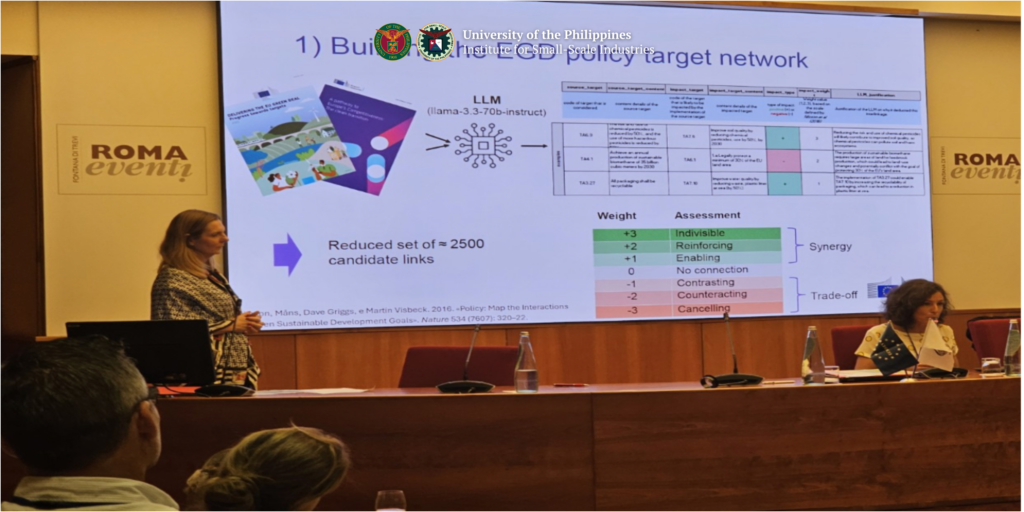 A presentation on European Green Deal policy coherence demonstrated the use of AI, expert validation, and network analysis to examine synergies and trade-offs among policy targets.
ROME, Italy — The University of the Philippines Institute for Small-Scale Industries (UP ISSI) participated in the 14th International Conference on Sustainable Development (ICSD 2026), held on 9–10 September 2026 at Roma Eventi within the Pontifical Gregorian University in Rome, Italy. Organized by the European Center of Sustainable Development in collaboration with CIT University, the conference carried the theme “Creating a Unified Foundation for Sustainable Development: Research, Practice and Education.” It brought together researchers, educators, and practitioners to exchange research and approaches on economic, environmental, and socio-cultural sustainability.

Representing UP ISSI, Nova Z. Navo presented during the first session of the Economic Sustainability track on the second day of the conference.

Philippine social enterprises on the international stage

Navo’s presentation examined how social enterprises can respond to persistent development challenges in the Philippines, drawing on the experiences of Rural Rising Philippines, Lamac Multi-Purpose Cooperative, and Bambuhay. The three enterprises were among the cases featured in MAScIGLA (Mobilizing and Advancing Science-Based Social Enterprises through Innovation and Guided Learning Towards Organizational Agility), a project implemented by UP ISSI with support from the Department of Science and Technology–Philippine Council for Agriculture, Aquatic and Natural Resources Research and Development (DOST-PCAARRD).

MAScIGLA was designed to assess and strengthen Agriculture, Aquatic and Natural Resources (AANR)-based enterprises as sustainable social enterprises through assessment, capacity building, guided learning, mentorship, and institutional strengthening. Its framework considers four interrelated dimensions—Social Mission, Social Business, Social Ownership, and Social Innovation—to examine how enterprises combine economic activity with social and developmental objectives.

The three cases illustrate different ways locally rooted organizations respond to development challenges.

Rural Rising Philippines uses innovative market linkages to connect farmers with consumers while addressing agricultural losses and food waste. Lamac Multi-Purpose Cooperative illustrates how sustained cooperative and community institution-building can support local development, while Bambuhay connects livelihood creation with environmental sustainability. Together, the cases show how social enterprises can pursue economic viability while responding to livelihood insecurity, market exclusion, waste, and environmental pressures.

Learning from international sustainability research

Beyond the Philippine cases, discussions at ICSD 2026 highlighted approaches that can inform research and practice in enterprise and sustainable development.

Selected presentations examined how policy targets interact within complex systems, how pathways toward circularity differ according to the motivations and capacities of enterprises and communities, and why converting waste into new products requires not only technological innovation but also technical validation, standards, market acceptance, and appropriate enabling institutions.

Conference discussions also highlighted the role of universities in sustainability transitions—not only as producers of research, but also as knowledge brokers, conveners, and institutions that connect government, enterprises, communities, and other knowledge actors.

These perspectives reinforce the value of examining sustainability as a system in which enterprises operate alongside policies, markets, institutions, communities, technologies, and knowledge organizations.

Strengthening the enabling environment for Philippine social enterprises

The presentation also comes at a time when efforts to strengthen the policy environment for social enterprises continue in the Philippines.

Several versions of proposed Poverty Reduction Through Social Entrepreneurship (PRESENT) legislation have been filed in the 20th Congress. The measures broadly seek to establish or institutionalize the PRESENT Program and strengthen public support for social enterprises as instruments for poverty reduction and inclusive development.

For example, Senate Bill No. 789 (https://senate.gov.ph/legacy/lis_bills/4733343333!.pdf) seeks to institutionalize the PRESENT Program, promote social enterprises with the poor as primary stakeholders, and strengthen support systems for social-impact economies. Other Senate versions of the measure have also been filed and remain pending in committee.

Similar measures have been introduced in the House of Representatives. These include proposals to establish the PRESENT Program and provide support, benefits, and appropriations for social enterprises. As of September 2026, several House versions—including House Bills 1250, 1830, 5064, 7169, 8745, 9206, and 10897—were listed as pending before the Committee on Micro, Small and Medium Enterprise Development.  (https://www.congress.gov.ph/legislative-documents)

The continuing legislative attention reflects a broader policy question raised by the Philippine cases presented at ICSD: how can an enabling environment help socially oriented enterprises remain economically viable while expanding their contributions to communities, livelihoods, and sustainable development?

Connecting Philippine experience with global discussions

UP ISSI’s participation in ICSD 2026 provided an opportunity to bring Philippine experiences in social entrepreneurship into an international discussion on sustainable development while drawing insights from research and practice in other countries.

The experiences of Rural Rising Philippines, Lamac Multi-Purpose Cooperative, and Bambuhay illustrate that responses to persistent development challenges can emerge from private enterprises and organizations deeply embedded in the communities and markets in which they operate. At the same time, international discussions at ICSD emphasized that such initiatives do not operate in isolation: their sustainability is influenced by policy, institutions, technology, markets, standards, knowledge, and collaboration.

As policy discussions on social-enterprise development continue in the Philippines, evidence from initiatives such as MAScIGLA can contribute to a deeper understanding of how enterprises, communities, government, universities, and other development actors can work together toward more inclusive and sustainable development.