Navotas Landfill Fire: A Warning We Can’t Ignore
A fire that broke out on April 10, 2026, at the sanitary landfill in Navotas has raised renewed concerns over the safety and long-term sustainability of landfill-based waste management systems in the Philippines. The fire reportedly lasted more than 20 hours before being declared under control, although smoke continued to affect nearby communities (de Guzman, 2026; GMA Network, 2026a).
The landfill had ceased operations in August 2025 but had not completed closure procedures, including proper capping and stabilization (GMA Network, 2026b). Environmental groups have described the incident as part of a broader pattern of landfill-related risks in the country (Greenpeace Philippines, 2026).
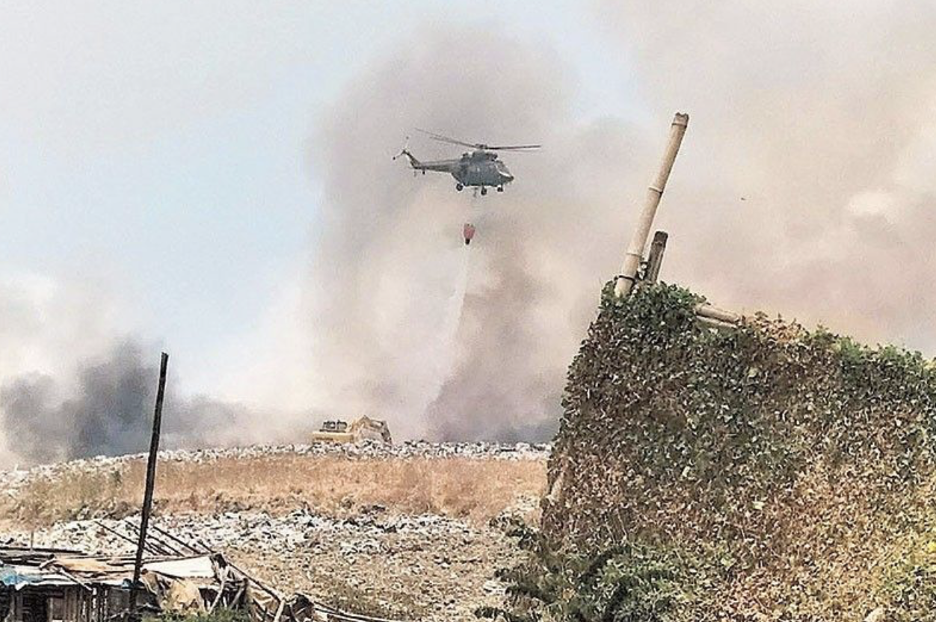
A Philippine Air Force helicopter helps suppress the Navotas landfill fire in Barangay Tanza 2 on April 11, 2026. Source: Navotas Public Information Office (2026), published in The Philippine Star.
Why Landfills Catch Fire
Landfill fires are commonly associated with methane accumulation, a natural byproduct of decomposing organic waste. When landfill sites are not properly sealed, oxygen can infiltrate waste layers, creating conditions for combustion.
Methane is highly flammable, and its buildup in unmanaged landfill environments can lead to both surface and subsurface fires, which are more difficult to control (World Bank, 2018). These conditions are often exacerbated by incomplete landfill closure and prolonged exposure of waste materials.
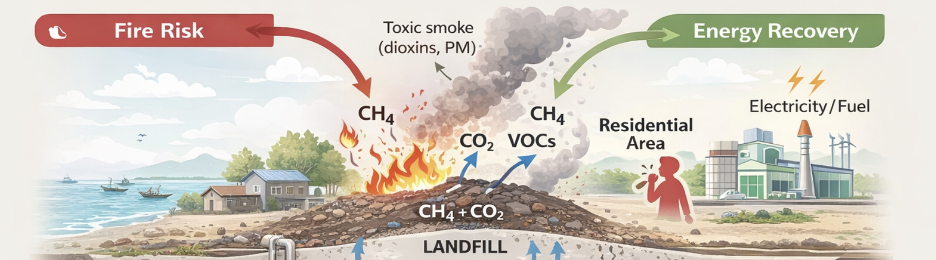
This diagram illustrates how organic waste in landfills decomposes to produce methane (CH₄), carbon dioxide (CO₂), and other gases. In the absence of gas capture systems, methane accumulates and, when combined with oxygen (O₂) and heat, can lead to combustion and landfill fires that release toxic pollutants. The figure also presents an alternative pathway where methane is captured and utilized for energy, reducing both emissions and fire risk. Subsurface processes such as gas migration and leachate infiltration further highlight the potential impacts on surrounding communities, soil, and water systems. [Image generated using artificial intelligence (OpenAI, 2026) based on author-designed inputs.]
Health and Environmental Impacts
Landfill fires release a complex mixture of pollutants, including particulate matter, carbon monoxide, volatile organic compounds, and persistent organic pollutants such as dioxins and furans. These emissions contribute to degraded air quality and may result in respiratory and cardiovascular health effects (U.S. Environmental Protection Agency [EPA], 2021; Wiedinmyer et al., 2014).
According to the World Health Organization, dioxins generated from burning waste can persist in the environment and accumulate in the food chain, posing long-term health risks (WHO, 2016). During the Navotas incident, residents were advised to limit outdoor exposure due to smoke-related hazards, with air quality levels reaching the “unhealthy” range in some areas (GMA Network, 2026a; GreenDev Solutions, 2026; Manila Bulletin, 2026). These conditions are largely driven by the release of fine particulate matter (PM2.5), which can penetrate deep into the lungs and pose risks to respiratory and cardiovascular health. Given the landfill’s proximity to coastal and fisheries areas, there are also concerns regarding potential contamination of marine ecosystems, which may affect food safety and livelihoods (Greenpeace Philippines, 2026).
A Missed Opportunity: Landfill Gas as an Energy Resource
Methane emissions from landfills are not only a hazard but also a recognized energy resource. Landfill gas can be captured through engineered systems and used for electricity generation, heating, or as a renewable fuel. Landfill gas recovery projects can simultaneously reduce greenhouse gas emissions and provide alternative energy sources, particularly in developing countries, especially when fossil fuel prices are high.
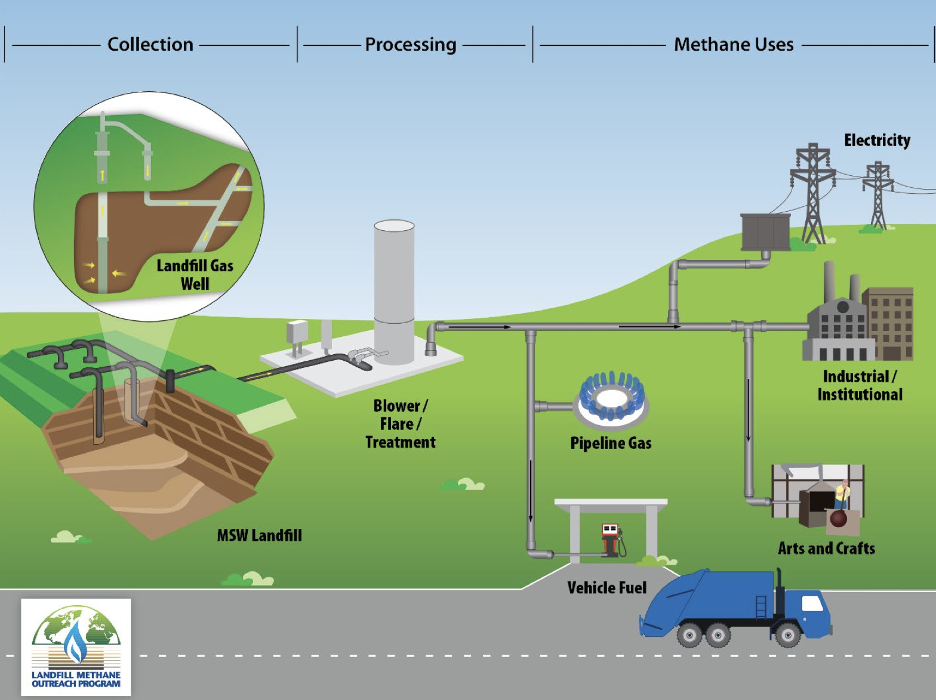
Landfill Gas (primarily methane) Collection, Treatment, and Utilization. Gas generated from decomposing waste is captured through wells installed within the landfill and transported via a piping system to a treatment facility, where it is processed through blowers and flaring or purification systems. The recovered methane is then distributed for various end uses, including electricity generation, industrial applications, pipeline gas, vehicle fuel, and small-scale uses such as arts and crafts. Overall, the figure demonstrates how landfill gas can be transformed from a waste byproduct into a valuable energy resource through proper collection and management systems. Adapted from U.S. Environmental Protection Agency (2021).
However, in many cases—including the Navotas landfill—such gas capture systems are either absent or incomplete. As a result, methane is released into the atmosphere or accumulates within waste layers, increasing both climate impact and fire risk. Methane has a significantly higher global warming potential than carbon dioxide over a 20-year period, amplifying its environmental significance.
This highlights a dual issue: unmanaged landfill gas represents both an environmental liability and a missed opportunity for resource recovery.
Policy Context: Philippine Waste Management Framework
The incident also raises questions regarding the implementation of existing waste management policies in the Philippines. The Republic Act No. 9003 mandates environmentally sound waste management practices, including waste segregation, recycling, and the use of sanitary landfills with proper closure and post-closure care. It also emphasizes waste diversion to reduce reliance on disposal facilities. More recently, the Republic Act No. 11898 requires large enterprises to recover and divert plastic waste, aiming to reduce the volume of waste entering landfills. Despite these policy frameworks, the recurrence of landfill-related incidents suggests ongoing challenges in implementation, monitoring, and enforcement.
Rethinking Waste Systems
The Navotas fire underscores structural gaps in landfill management, particularly in closure and post-closure phases. Proper landfill closure requires the installation of impermeable caps, gas collection systems, and long-term environmental monitoring. Incomplete closure leaves waste exposed to environmental conditions, increasing the risk of fires and emissions. Environmental organizations have also pointed to a pattern of landfill-related incidents in the Philippines, indicating broader systemic vulnerabilities (Greenpeace Philippines, 2026).
The incident has renewed attention on the limitations of disposal-based waste management systems. While sanitary landfills are designed to reduce environmental risks, they remain dependent on continuous waste accumulation.
Circular Economy as a Policy Response
From a policy perspective, the Navotas landfill fire illustrates key entry points for transitioning toward circular economy approaches:
- Waste prevention and reduction: minimizing the volume of waste entering landfills
- Material recovery and recycling: diverting recoverable materials into productive use
- Energy recovery: capturing landfill gas for energy generation
- Product design and responsibility: aligning with Extended Producer Responsibility requirements
Circular economy strategies focus on maintaining the value of materials within the economy for as long as possible, thereby reducing the need for disposal and mitigating associated risks. The Navotas landfill fire highlights both the risks and unrealized opportunities embedded within current waste management systems. The incident demonstrates that landfill sites, even after closure, can pose environmental and public health hazards when not properly managed. At the same time, the event underscores the potential for resource recovery—particularly through landfill gas capture—which remains underutilized. As similar incidents continue to occur, the case points to the need for strengthened implementation of existing policies and consideration of alternative approaches that prioritize waste reduction and resource efficiency.
References
De Guzman, M. (2026, April 12). Navotas sanitary landfill fire [Photograph]. The Philippine Star. https://www.philstar.com/nation/2026/04/12/2520323/navotas-landfill-catches-fire-affects-nearby-communities
GMA Network. (2026a). Navotas landfill fire now under control. https://www.gmanetwork.com/news/topstories/metro/983540/navotas-landfill-fire-that-started-april-10-now-under-control/story/
GMA Network. (2026b). Navotas landfill fire linked to unfinished closure program. https://www.gmanetwork.com/news/topstories/metro/983635/navotas-landfill-fire-linked-to-unfinished-closure-program-mayor/story/
GreenDev Solutions. (2026). Navotas sanitary landfill fire: Air quality index and safety insights. https://greendevsolutions.com/navotas-sanitary-landfill-fire-air-quality-index-safety/
Greenpeace Philippines. (2026). Navotas landfill fire latest in dangerous trend of waste disasters. https://www.greenpeace.org/philippines/press/69040/navotas-landfill-fire-latest-in-dangerous-trend-of-waste-disasters/
Manila Bulletin. (2026, April 13). “Wag masyadong lumabas”: Unhealthy air hits QC, nearby cities after Navotas landfill fire — DENR. https://mb.com.ph/2026/04/13/wag-masyadong-lumabas-unhealthy-air-hits-qc-nearby-cities-after-navotas-landfill-firedenr
United Nations Environment Programme (UNEP). (2019). Waste management outlook for Asia and the Pacific.
United Nations Environment Programme (UNEP). (2021). Global methane assessment.
United States Environmental Protection Agency (USEPA). (2020). Landfill gas emissions and energy recovery.
U.S. Environmental Protection Agency. (2021). Landfill gas energy project development handbook (Chapter 1). https://www.epa.gov/system/files/documents/2021-07/pdh_chapter1.pdf
Wiedinmyer C, Yokelson RJ, Gullett BK. Global emissions of trace gases, particulate matter, and hazardous air pollutants from open burning of domestic waste. Environ Sci Technol. 2014 Aug 19;48(16):9523-30. doi: 10.1021/es502250z. Epub 2014 Jul 28. PMID: 25019173.
World Bank. (2018). What a waste 2.0: A global snapshot of solid waste management to 2050.
World Health Organization (WHO). (2016). Dioxins and their effects on human health.