Advancing Circular Economy Adoption among MSMEs in the Philippine Food System: A UP ISSI and DOST-PCAARRD Initiative*
Micro, small, and medium enterprises (MSMEs) across the Philippine food system are under increasing pressure to improve efficiency, reduce waste, and adapt to evolving environmental standards. Yet for many, transitioning to more sustainable practices remains a challenge. They are constrained by limited technical capacity, unclear regulatory pathways, and insufficient incentives.
To address these gaps, the University of the Philippines Institute for Small-Scale Industries (UP ISSI), through its Research Division, is implementing a research and development project titled “Development of a Policy Framework to Incentivize the Adoption of Circular Economy (CE) Practices among MSMEs in the Philippine Food System.” Funded by the Department of Science and Technology – Philippine Council for Agriculture, Aquatic and Natural Resources Research and Development (DOST-PCAARRD), the initiative seeks to translate circular economy concepts into actionable strategies for both policymakers and enterprises.
Why Circular Economy, and Why MSMEs?
Circular economy practices such as waste valorization, resource recovery, and process optimization, offer practical pathways to enhance productivity while reducing environmental impact. In sectors like rice, hogs, and sardines, significant opportunities exist to transform by-products into valuable inputs, improve resource efficiency, reduce losses across the value chain, and increase or provide new income streams.
For example, rice husks can be used for energy generation, hog waste can be converted into biogas, and sardine processing by-products can be utilized for fishmeal or other value-added products. However, despite these opportunities, adoption among MSMEs remains limited. Existing policies and support systems are often fragmented, and compliance requirements can be difficult for smaller enterprises to navigate.
A Value Chain-Based Approach
The project focuses on three key commodity value chains—rice in Region III, hogs in Region IVA, and sardines in Region IX and Tawi-Tawi—selected for their economic importance and varying circularity potential. Rather than examining enterprises in isolation, the initiative adopts a value chain approach, analyzing opportunities for circularity from production and processing to distribution, consumption, and waste management.
This approach allows the project to identify not only enterprise-level practices, but also system-level gaps in infrastructure, policy, and coordination that influence the adoption of circular economy strategies.
From Research to Practical Tools
The initiative is designed to bridge research, policy, and enterprise practice. It will generate a set of outputs that are both analytical and practical, including a policy framework tailored to MSMEs, a circular economy guidebook, training modules, industry studies, and case documentation across the value chain. A knowledge-sharing platform is also being developed to showcase circular economy practices and facilitate collaboration among stakeholders.
To support this work, the project adopts a mixed-methods approach, combining nationwide surveys, field documentation, case studies, and stakeholder consultations. Documentation and measurement tools are aligned with emerging international standards, particularly the PNS ISO 59000 series on circular economy, ensuring consistency with global frameworks while remaining grounded in the Philippine context.
Building Shared Understanding
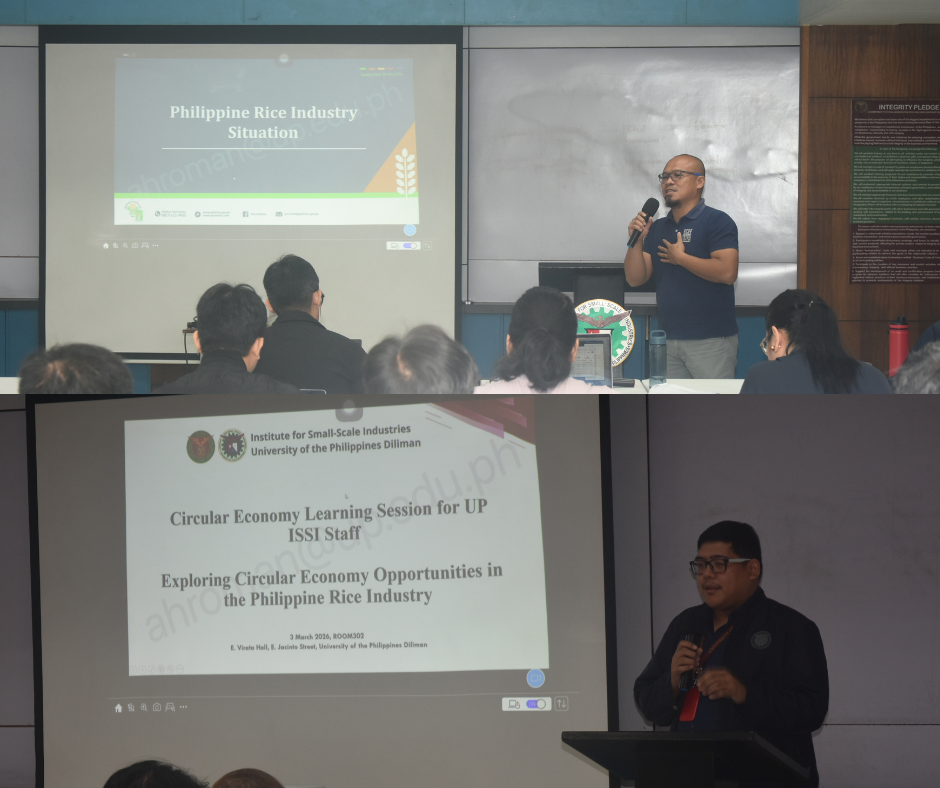
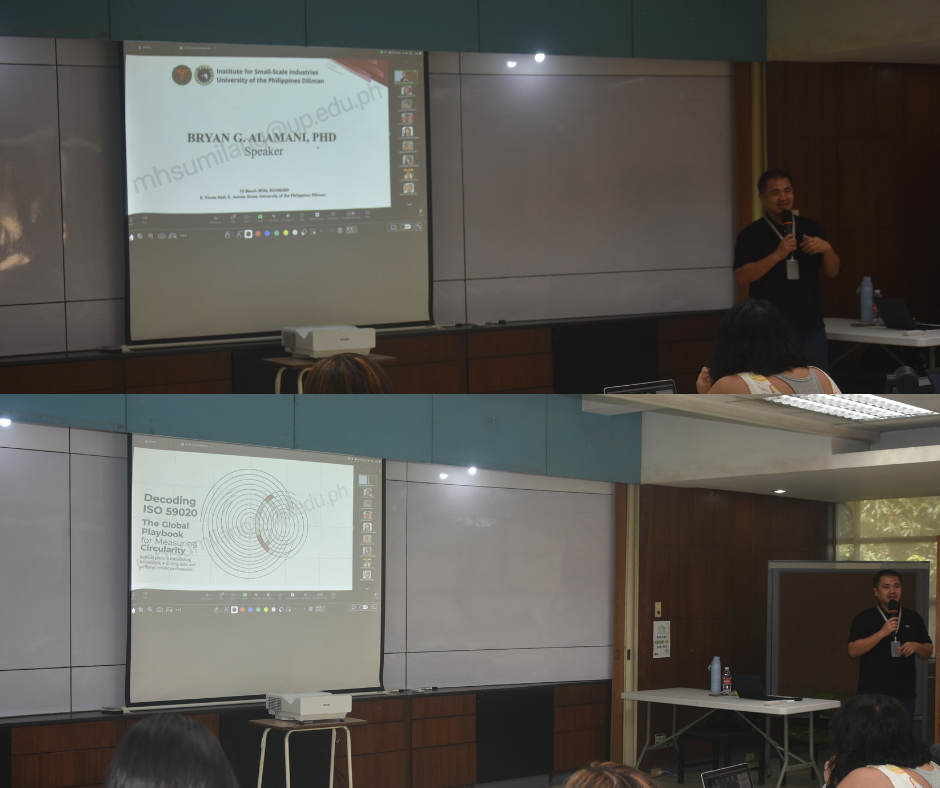
Recognizing that circular economy adoption requires a shared understanding across sectors, UP ISSI has been convening a series of learning sessions involving experts from academia, government, and industry. These sessions cover key topics such as circular economy principles, value chain analysis, circularity measurement, and sector-specific applications in rice, hogs, and fisheries.
Beyond knowledge sharing, these engagements serve as platforms for dialogue—allowing stakeholders to reflect on practical challenges, identify opportunities, and contribute insights that inform the project’s outputs.
Engaging Stakeholders Across the System
The project adopts a multi-stakeholder approach, working with national government agencies, research institutions, local government units, industry associations, and MSMEs. Key partners include agencies such as DTI, DOST, DA, DENR, and DOLE, as well as institutions like PhilRice, NFRDI, and state universities and colleges (SUCs).
Technical experts play a central role in the project. Circular economy specialists provide guidance on frameworks, measurement, and policy integration; while commodity experts in rice, hogs, and sardines contribute sector-specific insights, support value chain analysis, and facilitate engagement with industry stakeholders.
Developing and Validating the CE Policy Framework
An initial draft of the policy framework has been developed, identifying key national drivers, core pillars, and corresponding policy instruments to support circular economy adoption among MSMEs in the Philippine food system. The framework is currently undergoing gap analysis to assess alignment with existing policies and to identify areas where additional support, incentives, or regulatory adjustments may be needed.
As part of this process, the draft framework is being shared with stakeholders—including selected national government agencies—for consultation and validation. Initial presentations have been conducted to support early alignment, gather feedback, and ensure that the framework is grounded in institutional realities and industry needs.
Moving Toward Practical and Scalable Solutions
As the project progresses, its focus remains on translating circular economy principles into practical, scalable solutions for MSMEs. By linking research, policy development, and on-the-ground engagement, the initiative aims to make circular practices not only environmentally beneficial, but also economically viable for enterprises.
Ultimately, the project contributes to strengthening the competitiveness of Philippine food industries, supporting national goals on sustainability and resource efficiency, and enabling MSMEs to participate more actively in the country’s transition toward a circular economy.
——————
*This project is implemented by the Research Division of UP ISSI. For coordination and further information, you may contact Ms. Nova Navo, Project Leader, at nznavo@up.edu.ph or circulareconomy.issi.upd@up.edu.ph.