Entrepreneurial Information Services in the VUCA Era

Embracing community-centered services can transform unpredictable information technological changes into opportunities for engagement and support. MSME libraries and business information centers, as they evolve beyond their traditional roles, may consider navigating in the VUCA world as described by volatility, uncertainty, complexity, and ambiguity (Mahdi, 2023). Transitioning from information silos to a community-driven hub unveils new information services and flexible organization structures to address the rapid technological change and evolving entrepreneurial information needs (Jaskowska, 2020).
In the VUCA world, MSME libraries and business information centers become proactive community hubs that help counter misinformation, improve access to technology and virtual services, and promote critical thinking for lifelong learning (Riyanti, 2025). These evolving roles support the development of entrepreneurial digital literacy, turning challenges into opportunities for growth. As digital technologies advance, these institutions need to redefine their digital literacy programs by translating strategies into activities that foster essential entrepreneurial competencies to thrive in a VUCA environment.
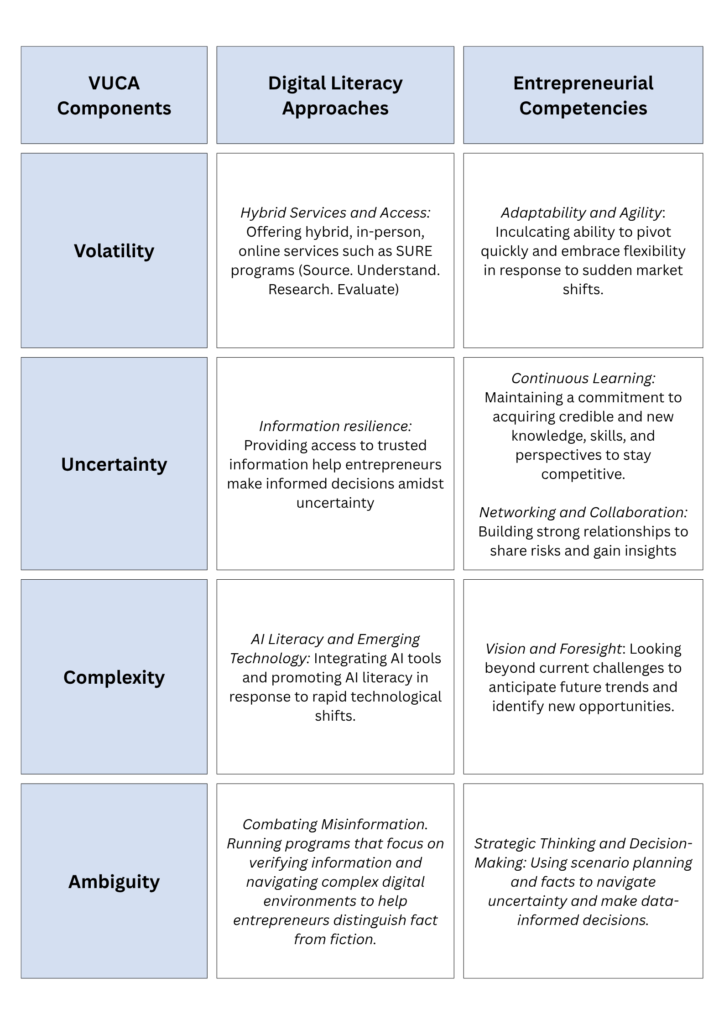
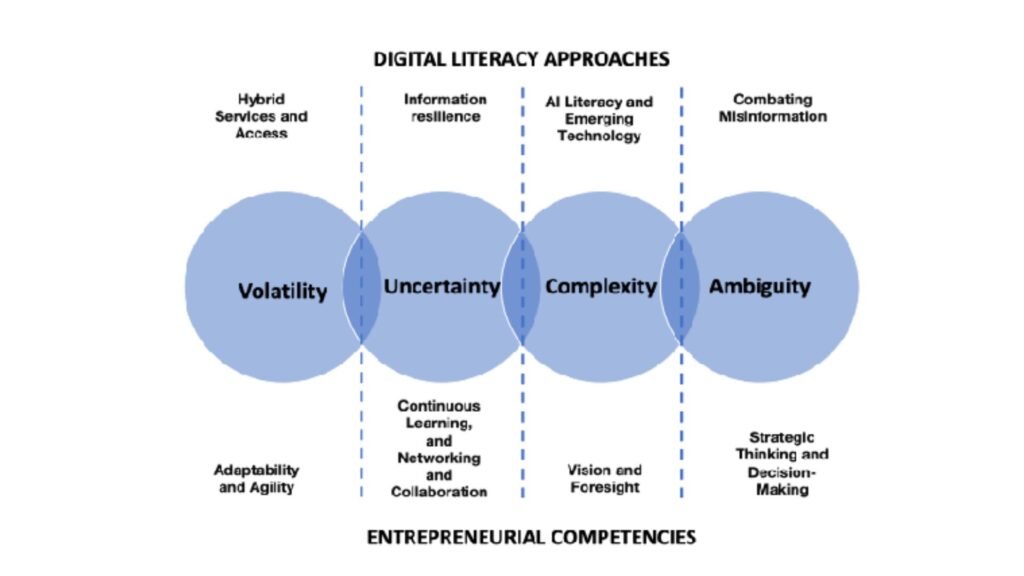
Although each VUCA component has its own characteristics that necessitate different strategies, the components overlap between the four aspects of digital literacy and entrepreneurial competencies (EU Business School, 2024). This signifies that two or more aspects of the VUCA world may occur simultaneously.
|
To assist entrepreneurs in navigating the sudden changes of the VUCA world, MSME libraries and business information centers may need to utilize a variety of digital literacy approaches. Consistently implementing and adapting these methods fosters agility in today’s business environment (Ehsani & Osiyevskyy, 2022). |
Bridging the Digital Divide
MSME libraries and business information centers serve as essential community resources, providing entrepreneurs with lifelong learning opportunities. These institutions play a pivotal role in bridging the digital divide by establishing community-based access hubs and implementing tailored literacy programs that promote economic participation and entrepreneurial success (Olipas & Alegado, 2025; Gupta, 2026). Digital literacy initiatives focused on digital marketing, artificial intelligence, and data analytics further support business sustainability (Istikomah et al., 2026), particularly benefiting women, persons with disabilities (PWD), and marginalized entrepreneurs.
Unlocking Opportunities for Women through Digital Inclusion
Digital literacy programs tailored for women in low- and middle-income countries significantly expand opportunities for women entrepreneurs to participate fully in the digital ecosystem, positioning digital transformation as a catalyst for gender equality (Javed et al., 2025). Providing new avenues for women entrepreneurs to acquire high-demand digital skills can generate a “snowball effect,” resulting in improved livelihoods and increased leadership among rural and indigenous women (United Nations Sustainable Development, 2026). Relevant programs may address market access, digital skills, artificial intelligence, and cybersecurity. Effective implementation strategies include peer learning through small groups to foster safe learning environments and mentorship with post-training support to ensure sustainable growth.
Inclusive Services for Persons with Disabilities (PwDs)
Given the complexity of a VUCA environment, MSME libraries and business information centers may streamline information access across multiple technological platforms to address the specific needs of PwDs. Establishing a clearer pathway for them requires specialized library programs and training, safe learning spaces that accommodate diverse needs, and inclusive digital collections that provide expanded access to eBooks with customizable settings (International Federation of Library Associations and Institutions, 2026).
While barriers remain in sojourning alone on this pathway, it is crucial to establish strong partnerships with both local and international organizations. This collaboration empowers MSME libraries and information centers to offer essential digital training and engaging learning workshops for persons with disabilities (PwDs), ensuring they have the opportunities and skills necessary to succeed in the digital landscape.
Paving the Way to Digital Equity: From Margins to Mainstreams
Digital literacy programs play a crucial role in bridging the digital divide and empowering marginalized entrepreneurs, helping them move “from the margins to the mainstream.” These programs are designed to inculcate individuals with the essential technical skills, digital marketing knowledge, financial literacy, and online safety practices. This enables them to start or grow a business and reach a broader market (Hamidi et al., 2025). Some examples of these programs include the use of digital technologies for livelihood enhancement, such as mobile phone-based training, live selling, and seller center tools.
Despite challenges in infrastructure, such as poor connectivity and cultural barriers, a community-centric model can be implemented. This approach places local residents and stakeholders at the forefront, allowing for the customization of solutions to fit the specific needs of the community (Doloi, 2018).
Building an Inclusive Entrepreneurial Community
Emphasizing community engagement enables MSME libraries and business information centers to become dynamic environments where entrepreneurs acquire technological problem-solving skills (International Federation of Library Associations and Institutions, 2025) and succeed within a complex economic landscape (Suchanic et al., 2023). These centers can function as trusted anchor institutions that support entrepreneurs encountering systemic barriers, offer specialized databases and tools for startups, facilitate connections with local mentors, peers, and funding sources, and deliver tailored mentoring and networking opportunities.
References:
Doloi, H. (2018). Community-Centric Model for Evaluating Social Value in Projects. Journal of Construction Engineering and Management, 144(5). https://doi.org/10.1061/(ASCE)CO.1943-7862.0001473
Gupta, V. (2026). Libraries as Hubs for Entrepreneurship: Support, AI Experimentation, Practical Technologies, Monitoring, and Evaluation. Springer Cham.
Hamidi, I., Pratama, D., Bashir, A., & Apriani, D. (2025). Transforming Marginalized Entrepreneurship: Digital Skills and Market Adaptability for MSMEs in Emerging Economies. PENA DIMAS Journal Pengabdian Masyarakat 4(1). https://doi.org/10.33474/penadimas.v4i1.27665
International Federation of Library Associations and Institutions. (2026, January 23). Guidelines for Inclusive Library Services for Persons with Print Disabilities. https://www.ifla.org/news/guidelines-for-inclusive-library-services-for-persons-with-print-disabilities-2/
International Federation of Library Associations and Institutions. (2025, December 19). Just out from IFLA/De Gruyter: Libraries Empowering Society Through Digital Literacy. https://www.ifla.org/news/just-published-libraries-empowering-society/#:~:text=Subsequently%2C%20a%20call%20for%20papers,the%20library%20and%20information%20professions.
Istikomah, I., Maulana, A., Susilawati, S., & Muchsam, Y. (2026). Artificial Intelligence and Digital Literacy for Competitiveness and Sustainability of Bandung MSMEs. International Journal of Multidisciplinary Sciences and Arts, 5(11), 10–19. https://doi.org/10.47709/ijmdsa.v5i1.7580
Jaskowska, B. (2020). Organizational Flexibility of Academic Libraries in a Vuca Reality: The Example of the Functioning of Libraries During the Covid-19 Epidemic. Przegląd Biblioteczny, 88, 70–93. https://doi.org/10.36702/pb.773
Javed, A., Ashraf, M. Z., & Shahbaz, S. (2025). Digital Transformation and Its Influence on Women’s Economic Empowerment in Pakistan. Sustainable Futures, 19. https://doi.org/10.1016/j.sftr.2025.101092
Mahdi, R. (2023, November 9). VUCA Era: The Challenge for Libraries to Empower the Community. https://medium.com/@rezamahdi_11316/vuca-era-the-challenges-for-libraries-to-empower-the-community-757b866b93b7#
Olipas, C. N., & Alegado, R. (2025). Bridging the gap: Enhancing digital literacy and access among rural students in Nueva Ecija, Philippines. Multidisciplinary Reviews, 9(2). https://10.31893/multirev.2026317
Riyanti, A. (2025). The Role of Libraries in Improving Digital Literacy and Preventing Misinformation Among Students. Bibliogia, 2(2), 8–14. https://doi.org/10.62872/ecsgrw22
Suchanic, E., Pond, M., & Perry, M. (2023). The role of public libraries in urban entrepreneurship. Journal of Urban Regeneration & Renewal, 16(3), 267. https://doi.org/10.69554/kycb3718
United Nations Sustainable Development. (2026, March 9). How Digital Inclusion is Transforming the Lives of Rural Women and Girls in Chile. https://unsdg.un.org/latest/stories/how-digital-inclusion-transforming-lives-rural-women-and-girls-chile